Monday, 25 June 2012

Close Encounters


How we spent our first anniversary


The sensation is exhilarating, but tinged with just a little bit of fear. We are whizzing along over a seabed of sand and rubble - a fast current of over 5 knots carrying us across this barren moonscape. An occasional boulder sized head of coral is all that breaks the monotonous terrain, and means that you have to keep one eye on the direction of travel lest you collide with them. You can't help but put your arms out like a pair of wings, and if you didn't have a regulator in your mouth then you would be crying out “Weeeeeeeeeeeeeeeeee!!!!”.

Harriet learning to fly

Then we hear it - the 'tap tap tap' of Ed, the dive leader, indicating that there's something of interest. As we've been prepped, this means it's time to hunker down against the seabed and find something safe to grab onto, as the current swings us round to point us up stream. Beyond Ed I can just make it out. The visibility is very good at about 20 metres, but it is only the vaguest of shapes at first, nothing more than a shadow. Slowly it becomes more defined, gliding towards us a couple of feet off the bottom. Soon we can see its wing tips curling up and straightening as they beat in a slow, graceful motion. By now it's clearly identifiable, although there was never any doubt - they don't call this place Manta Point for nothing.

This first Manta Ray is massive, with a wingspan of maybe 3 metres, and it's heading upstream, oblivious to the current we're fighting. It comes up on our left hand side, only 4 metres away, before banking right and gliding straight through the middle of the group. I'm dumb struck, in absolute awe as I stare into the face of this alien creature.

Close encounters of the Manta kind

A tight feeling in my chest brings me back to reality, I've been holding my breath for the past 30 seconds without realising it. I take a long exhale and check my pressure and depth gauges. When I look back up, the Manta is some distance off to our right, gradually fading back into the blue.

Letting go of our rocks, the current immediately picks us up and we are flying once more. But no sooner has the first manta gone then we hear it again...'tap tap tap'. Finding purchase on another rock, this time there are three shapes. The leader is huge, a beautiful black spaceship. I fumble with my underwater camera and manage to start recording some video. I'm so focused on filming the leader as he passes within a metre of me that I don't see the second ray. He buzzes past only inches above me, and I instinctively duck. I can imagine the pair chuckling to themselves over that one.


We release ourselves once more and glide on. The taps now come thick and fast, no sooner has one Manta disappeared then another is approaching. They seem more than just tolerant of our presence, they are positively inquisitive, and you can sense the intelligence behind that alien face.

Manta 1 on final approach

Ed signals once more, but I can't see the Manta this time. It's only when I'm within 5 metres that I notice the grey shape lying still on the seabed, a 2 metre long white tip reef shark. This guy is a little more shy, stirring himself from his bed, and with a casual flick of his tail he disappears.
By now the current has eased somewhat, and the previously barren floor is populated with soft corals and anemones, swaying like fields of wheat blown by the wind. We come across a turtle, nestled down amongst soft coral pillows. They always appear chilled out creatures, but you can tell this one is particularly languid. We 'tiptoe' past quietly so as not to disturb him.

Sleeping beauty

Our air is starting to get low now, so we make a safety stop at 5 metres, hanging around a large coral boulder and checking out the reef fish. But you can tell that everyone's minds are elsewhere, thinking about the past 40 minutes and the amazing experience we have just had. We surface, and the smiles on everyone's faces tell the story. With the regulators out of our mouths we can finally communicate our excitement. The smiles last all day.

This was the most memorable day of the five we spent on Kanawa, a tiny island off the coast of Flores and on the edge of the Komodo National Park. The island is uninhabited save a dozen simple beach bungalows, although we took the rare opportunity to unpack our tent and camp under a berry tree. Kanawa is fringed by a bleached white sand beach, which gives way to turquoise waters dotted with patches of coral, before dropping off into the dark blue of deep water. We've seen more than our fair share of priceless islands on our travels, but this one might just take first prize.

Desert island castaway on Kanawa

From Kanawa we took a boat over to explore Komodo Island itself, whose jagged savannah covered ridges look like the land that time forgot. And forgotten it must have been, for the Komodo dragon is like something out of pre-historic times. Getting within six foot of one you realise that round here man isn't necessarily at top of the food chain. Although usually placid, occasionally they do attack and kill people, and it's best to stay behind your guide who is armed with a forked stick!

Komodo Dragon basking in the sun following his late lunch

With only a week or so left in Indonesia, we reluctantly had to tear ourselves away from Kanawa, and head to the much busier islands of Lombok and Bali. It's quite a shock to see tourists suddenly outnumbering locals. A few days surfing on the south coast of Lombok was followed by a day up in the hills of the lush interior, before descending to the coast for a last bit of beach time. 

Our final stop in Indonesia is the town of Ubud, the cultural heart of Bali. Although the traffic choked streets and constant calls of “Taxi Mister?!” are a little off putting, just a short walk away from the hustle and bustle is the rice field scenery that Bali is famed for. It's very interesting to watch the local Balinese families head off to the temples in smart colourful costumes with wicker baskets of tasty offerings for the Gods. After meeting Muslims in Java and devout Christians in Sulawesi, experiencing a little of the Hindu culture found only in Bali is an interesting way to end our time in this fascinating country.

Karl
 

The sun sets on our time in Indonesia


Thursday, 7 June 2012

Indonesia- highlights and harder times


Indonesia is big. It's really more like a group of separate countries - an island chain stretching across three time zones and with diverse culture, religion, and scenery. We began our explorations back at the end of April in Java, a place Karl visited on his last big trip over ten years ago and had fond memories of. Time had faded his recollection of the distances involved, so it was a surprise to both of us quite how far apart everything was. There were three places Karl especially wanted to revisit, and on the map it looked straightforward. In reality it took at least ten hours on cramped and bumpy buses or hot, crowded trains to get between each of these spots, and travel here quickly became draining.

Noodles for breakfast!
These are the parts of backpacking so often ignored in accounts, blurred by nostalgia or even forgotten. It's natural to focus on the highlights, but there are also days which aren't actually that enjoyable! Between every picture of a beautiful waterfall, surf break or national park are the unrecorded hours of uncomfortable travel. The hot and sweaty waits in bus and train stations; the lugging of a backpack around a traffic filled and stressful town to find a dirty room to stay in for the night; the enforced alarm clock of the 5 am call to prayer; the boredom of a noodle and rice based diet (it's hard work being vegetarian here); the frustration when travel plans fall through and you get stranded somewhere you really don't want to be; and the disappointment when all the effort to get to somewhere doesn't pay off. This is how we are choosing to spend our lives at the moment, and most of the time the rewards are well worth the effort, but sometimes days can go by between these highlights. We try to embrace the experience whatever happens, but it can be a little trying at times!

Smiles in Java
In Java and Sulawesi, what made everything worthwhile were the people. Everywhere anybody travels in the world there's the cliché of 'the people are so friendly', but it often really is the case, and nowhere we've been in Asia more so than here. In every village there'd be an enthusiastic welcome; workers in the rice paddies would stop to wave, children run over to greet us, and generally we'd feel a bit like celebrities. When our rented motorbike died people stopped what they were doing, phoned friends, gathered tools, and generally went out of their way to come to our aid. It's comforting to know you can't go far wrong before someone here will help you out. We've had some less positive encounters too, but for every person who tries to rip you off or mislead you, there are dozens more who are kind and genuine.

You never have to wait long for a bemo!
Our travel in Indonesia has involved a lot more time in towns and cities than we would ideally like. Although often hot, tiring and dirty, they give a more realistic view of what life is like here for most people than beauty spots ever could, and the markets and street food are particularly interesting. Negotiating a public transport system that consists of hundreds of identical blue bemos (small minibuses), each blaring hip hop music and covered in Britney Spears transfers and 'Jesus inside' stickers, is surprisingly fun. You don't really want to be a pedestrian here, where gaping holes in what pavements there are drop into stinking drains full of rubbish. We've got to know the towns and cities by jumping from one bemo to another, no-one minding our rucksacks taking up a whole space and pushing against them, our fellow passengers helping us with language tips and ensuring we get off at the right point.

Posing for family portraits
Many days in Indonesia we haven't seen any other foreigners, which is really refreshing after some of our travels in India and Thailand. Sometimes the most memorable experiences are in the least likely places- like the shopping mall in Makassar where we went to look for an umbrella, but ended up in the midst of a throng of people all keen to shake hands and practice their English. When we got in the lift we had about twenty people cram in with us just for the ride! Being slightly further off the South East Asia backpacker trail, we've felt more immersed in the country and have been trying hard with our Bahasa Indonesian. People here make it easy to have a go at their language- they don't laugh at our pronunciation or lack of sentence structure and it's amazing how much you can communicate with a very small vocabulary.

Catching a wave in Batu Karas
We're now six weeks into our two months in Indonesia, and have still only scraped the surface really. In Java , the best few days were spent at Batu Karas, a little fishing village with a black sand beach and famed surf. The point break was small enough for me but still good enough for Karl. Surfing here was much easier (not to mention warmer) than it is in England, with a consistent, relatively gentle wave peeling away from the headland. A highlight of the trip for me was surfing the wave all the way in to the beach- a ride of maybe twenty seconds (a long time in surfing!). Arriving at the beach, already feeling pretty chuffed, I couldn't stop smiling when I got a round of applause from a group of muslim ladies, wading in the shallows in their hijabs.
Gunung Bromo National Park in East Java was a complete change of scene- high up, cloudy and really cold! Here there are thick woolly socks for sale, cabbages growing instead of bananas, and, even under two blankets, it's chilly at night. The attraction is a massive volcano crater, 10 km across, with 3 newer volcanoes inside. The crater has wildflower filled savannah grasslands and the atmospheric 'sea of sands' where mist swirls around beneath the steaming summit of Gunung Bromo. A unique scene, especially when viewed from above a cloud inversion at sunrise.

Watching sunrise at Gunung Bromo

The amazing coral reef at Pulau Bunaken
We left Java to fly to Sulawesi, a bizarre shaped island east of Borneo. After exploring the interior (see the last blog on the Tana Toraja), we travelled to Pulau Bunaken off the northern tip of Sulawesi to snorkel and dive on probably the best coral reef I've ever seen. Every square inch covered in hard and soft corals, the reef swarming with colourful fish and, as the divemaster said, 'so many turtles you'll be kicking them out the way'. The coral reef rings the island just 100m offshore before dropping far into the blue at a vertical wall with excellent drift dives. We had to drag ourselves out of the sea here!

Tarsiers- always surprised!
Away from the water the wildlife of Sulawesi was plentiful too. We visited a national park where on guided walks we saw huge hornbills in the trees, a playful troop of macaques, the rare bear cus-cus and, best of all, the extremely cute tarsiers, whose huge eyes give them an appearance of constant surprise.

Leaving Sulawesi, we journeyed to West Timor. The people here resemble aboriginals in appearance, and we haven't found all of them to be quite as welcoming- or maybe that's just our experience, mainly based on an aggressive public transport mafia. Kupang in West Timor is just another town we keep getting stuck in en-route to places we actually want to be! It does have a fantastic street market at night where you pick your fish for the grill, alongside fresh avocado juice to drink.

Alluring waters of Alor
From Kupang we flew to Alor at the eastern end of the Indonesian island chain. We loved it here, staying on a tiny rocky islet with white sand beaches, in a fantastic guest house run by a French couple. In the morning our dive boat would motor along channels between undeveloped, forested islands, passing tidal races and whirlpools. There was an exciting moment when we spotted a whale surfacing, his shiny back reflecting the sun and the vapour cloud lingering long after he'd returned to the deep. The diving was unlike anything either of us had experienced, with challenging currents making it more like an adrenaline sport than the usual relaxed scuba chill-out session. It was really interesting though, speeding along underwater cliffs and spotting quite a few new marine creatures. We slept in a traditional thatched Alorese house with the sound of waves lapping on the shore. Delicious meals were eaten together, family style, the couple's two sweet little girls running around, and evenings spent chatting to the other guests.                
One evening there was a party for the islanders to celebrate the completion of a new boat. They danced around a banyan tree to the beat of a drum (accompanied by the local palm wine home brew), singing a traditional melody about being far from home. On our last night we swam under the stars, the water so clear that you could see the fish by moonlight. A real haven, and just the break we needed from harder travels in Indonesia!

Our Alorese house

Lion fish at Alor

Karl heading off to surf at T-Land
 Now we're in a very different sort of place, on the island of Rote off West Timor. Closer to Darwin in Northern Australia than Jakarta, the scenery is much drier, with golden grasses, scrubland and long windy beaches. We're staying at a spot called Nemberela with big surf, but not a lot else. There's an odd mix of seaweed farming locals living in ramshackle thatched huts on the beach, and luxury foreign owned 'surf resorts' for holidaying Australians. It's not got a lot of character but, like all the tourists here, we came for the surf. Unlike Java the break is not for beginners, so I'm reluctantly playing the 'girlfriend holding the towel' role, watching the head-high wave breaking on the reef beyond the beach with binoculars, while Karl takes a boat or does the long paddle out for three sessions a day on a break called 'T-land'. It's a shame most surfers here don't tear themselves away from the water long enough to look around. We explored the coast by bike and the scenery was amazing; limestone headlands, caves and arches, turquoise lagoons, mangroves, deserted beaches and fishing villages with seaweed drying on racks in the sun.

Looking out to sea on Rote
From here we'll travel to the island of Flores, where we hope to unpack our tent for the first time in Indonesia, ideally on a desert island, visit the dragons of Komodo national park, dive with manta rays (fingers crossed), and, of course, seek out some more surf!

Wednesday, 6 June 2012

Trekking in the Tana Toraja


Language difficulties and 'Shaun The Sheep' in the heart of Sulawesi


Tana Toraja scenery
We had thought it would be straightforward to find somewhere to stay in the Tana Toraja- naïve optimism combined with an inflated opinion of our very basic Bahasa Indonesian convinced us that we could turn up at a village at nightfall, armed with the magic phrase 'Saya kari tempat tidur tolong' (I would like a bed for the night please), and locals would be falling over each other to offer their hospitality. It didn't work out quite like that, but it did work out. 
The first family we asked shook their heads with some vigour, eventually pointing to a house down the road and telling us 'losmen' (guest house). Wow, a guest house? We weren't expecting that....neither was the owner of the house, which emphatically was not a guest house. When we asked him if there was anywhere in the village we could sleep he shrugged, and eventually and without much enthusiasm said 'I'll ask my mother'. It was starting to get dark now, so luckily his mum agreed and we were shown upstairs and offered tea. The conversation was stilted to say the least, but we managed to learn quite a lot about each other none the less. We felt pretty guilty for imposing like this, but our host and his mother's friendliness towards us grew, aided by lots of smiling if not much actual conversation.

Torajan houses and rice barns
It had been a very interesting day. We wanted a proper adventure, and that this was. Armed with a map, the essential phrase 'Ke mana' (Which way?), and not much else, we'd set off on an exploration of the Tana Toraja. This is a fascinating area of Sulawesi with a very strong traditional culture. The most notable feature is the architecture of  wooden houses and rice barns on stilts, covered with beautiful carvings and an oversized curved roof shaped like a pair of buffalo horns. 


Cliff tombs and tao tao

Torajans are devoutly Christian, but with an unusual twist in their attitude to death. Funerals are the most important events in the calendar, often lasting days and consuming a life time of savings, with valuable buffalos and dozens of pigs slaughtered for the occasion. After the funeral the coffin is either placed in a tomb carved out of a cliff, in a cave, or even hung in a tree. These cliff tombs and cave graves are everywhere, the coffins piled up and sometimes rotting, with bones and parts of corpses sticking through. In front of the caves are placed effagies of the deceased called tao tao, grouped together on wooden balconies so they look like spectators at a sports event. It's all very odd and I think unique to this area. 

Despite the amount of money spent on the dead, the villages still seem very prosperous and each family has quite a number of traditional tongkonan houses and rice barns. When you picture traditional tribal areas it's easy to fall into the trap of imagining a way of life preserved as in a living museum, unchanged for hundreds of years. This wasn't the case here, with satellite dishes and motorbikes as much a part of life as buffaloes and ceremonies. The torajans have held on to many of their traditions while still embracing some of the comforts of modern life.

Karl helps build a house!
Earlier in the day we had stumbled upon a celebration to mark the completion of a massive tongkonan. The old man who's building it was invited us over, his wife gave us coffee and Karl got to help in the raising of a large cross that formed the final support of the house. On the count of  'satu, dua, tiga' three teams of men on different ropes pulled with all their strength to raise the massive structure a few more millimetres. The whole community was there to help and there was a bit of a party atmosphere, with our appearance adding some novelty to the event. 


Karl and his entourage
This was the great thing about our trek- with no guide and no fixed route, we wandered through villages not knowing what we might come across next. The common feature was the interest the villagers showed in our arrival. Usually it would start with a group of children giggling and shouting 'bule bule' (foreigners). They were fascinated by us, but usually too shy to respond when we asked them their names. The adults would greet us warmly, often asking us where we were from, while some would go a step further. Like the old lady Maria and her husband Jakob, dressed in their sunday best on their way back from church, who showed us up to their balcony for coffee. Maria kept talking fast, long sentences and didn't seem to quite understand that we could speak barely any Bahasa Indonesian. Luckily she seemed satisfied with us smiling and nodding.

A landscape of rice paddies and villages
We had a compass with us but couldn't get lost with so many helpful people around, going out of their way to find out where we were headed and point us in the right direction. In this way we travelled from village to village, through a scenery of hillsides terraced into verdant green rice paddies, pine forested ridges with views into valleys of rushing rivers, attractive tongkonan in every village and cave graves and tombs in between.

Petrus helps Karl with Bahasa Indonesia Level 1!
On our second night we enquired at a village shop (a wooden shack) about accommodation. After serving us tea the shopkeeper, Petrus, sorted out everything for us. Initially he took us to his family house where we tried our hardest at conversation, aided by a very limited phrase book and Petrus' patience. We saw a lot more of village life accompanied by Petrus than we ever would have on our own
The tongkonan were arranged around dusty open yards where the community gathered, sifting baskets of rice, packing avocados for the market, children playing badminton or 'keepy uppy', women sitting on their front steps chatting. The men were gathered in a shelter akin to the village pub, wrapped in traditional patterned cloth that made it look a little like they were wearing their bedsheets.

Torajan village life (complete with satellite dish!)
That night we stayed with Petrus' brother and his family, who were very welcoming and didn't seem to mid that we couldn't answer many questions. Despite the elaborate woodwork on the outside of the buildings, furniture seemed to be completely lacking inside the house. Mats were laid out on the wooden floor for us to sit on, but the only object in the room was a TV. After we'd exhausted our conversation skills with the family (which didn't take long) we all sat and watched Shaun the Sheep- a perfect choice to traverse language boundaries! At night we were shown to a thin mattress in a room so dusty I was scared to shift position in case clouds of it fell in our faces. After a not entirely restful night came an early start- at 5.30 am the TV was blaring at maximum volume and everyone was up, the kids having combs dragged through their hair as they were got ready for school. This was village life, and there was nothing for it but to get up! 

Contouring between rice paddies with expansive views
After a breakfast of noodles and spinach, we set off on the third and last day of our trek. It was the most scenic section, contouring along a hillside between rice paddies. The path teetered along the mud wall between the pool of one rice paddy and the drop to the next terrace, and we passed through attractive hill side settlements far from the road, finding the way by following school children on their way home to their villages. 


It was a long day and we arrived back in the town of Rantepao well after dark. The awaiting hot shower, beer and soft bed were so very welcome, but it's those three improvised days we spent out in the Tana Toraja that we will remember best from our time in Sulawesi.

Saturday, 26 May 2012

Island Hopping in Thailand


Finding Nemo, snorkelling in Thailand

My reunion with Harriet after 3 weeks apart was not quite as I had planned. I arrived in Phuket, Thailand, from the UK after a relatively easy journey involving one train, two planes, a bus and a taxi, in a little over 24 hours. I passed the time waiting for Harriet by lazing on the beach and snorkelling just off it. Harriet's journey on the other hand covered a much shorter distance than mine, but in a similar amount of time, and without any food or sleep. So by the time she arrived at our beach side bungalow, she was looking forward to food, beer and rest. Unfortunately she wasn't going to get any of these, as literally the minute that she turned up, rucksack still on and before we'd even seen each other, the tsunami warning sirens started to sound. A large earthquake in Indonesia had just occurred, and a tsunami alert had been issued for the entire Indian Ocean. She didn't know any of this- just that the staff were running around frantically, too busy emptying the cash register and running up the hill to answer her questions as to what was going on. We found each other and hastily followed the example of the staff in retreating to high ground. 

So our first evening reunited was spent on a headland overlooking the ocean, waiting for an '8 metre wave' that might not even appear. We were unsure if this was a common occurrence or how serious it might be, although later found out it was only the second warning the system had ever issued, set up after the devastating tsunami of Boxing Day 2004. In the end, the wave arriving at the coast of Thailand was officially measured to be 5cm high and thus lost in the chop. However, it did bring home to us the vulnerability of this part of the world, and it was reassuring to know that a working warning system was in place.

With Bill and Sengduan in Phuket
We chose to meet up again in Phuket as it was easy for us both to get to, and had the added bonus of being where Harriet's uncle lives. Having only met Bill once or twice as a child it was nice for Harriet (and myself) to establish some connections with distant family. Bill and his wife Sengduan took us out to lunch, put us up in one of the apartments that they own, and even loaned us a motorbike for our time in Phuket. Phuket is a large island adjacent to the Thai mainland, blessed with something like 17 golden sand beaches. But the curse of Phuket is that the powers that be have selected it as Thailand's premier tourist destination, and construction and development has run rampant, entirely uncontrolled, and spoiled the very reason people would want to come here in the first place. Every bay along the west coast is surrounded by condominiums and resorts, over-run with jet skis and inflatable sausage rides, and defaced by endless lines of plastic sunbeds bearing speedo clad russians. However, with access to our own transport, we spent a day driving the back roads that link each of the bays, and were pleasantly surprised to find some less developed beaches and villages.

A young girl outsized by her super soaker
Our time in Phuket coincided with the Thai New Year celebrations of Songkran, which is best described as a national water fight, with a motto this year of "the wetter the better".0Families set up camp outside their houses with every water container they have, and proceed to soak anyone and everyone passing by. Pick-up trucks cruise the streets loaded with water filled barrels and gangs of youths armed with super soakers. Anyone is a fair target, even policemen.

Joining in with Songkran on Phuket
We joined in with gusto, being a bit shy at first in attacking complete and innocent strangers, but soon getting into the swing of things - I found that small children made slow moving and easy (but perfectly legitimate) targets!

After a few days in Phuket we were more than ready to leave and head to Railay, a dramatic headland with cliff-backed beaches accessible only by boat, which happens to be the sports climbing capital of Thailand and was much more our scene than Phuket! The landscape in this part of Thailand consists of vertical limestone buttresses shooting up out of beautiful blue ocean and fringed in thick green jungle. The setting is truly amazing, right out of 'The Beach'. We rented a kayak and spent a day exploring the indented coastline and offshore islands, finding a couple of hidden beaches along the way and some overhanging cliffs to have a go at deep water soloing. We were also able to hire climbing gear, to tick off some of the rock routes. The climbs were typically very steep and at a rather hard grade, and the intense heat just sapped our energy, but we managed an afternoon at a couple of different crags with stupendous views, and got a feel for the climbing on offer here. Despite our exertions there, Railay was a nice place to chill out, and we would have stayed longer had Harriet's visa not been fast running out.
Climbing in Railay- the view wasn't bad

The secret world through the Emerald Cave
So we left Railay to island hop down the Andaman coast towards Malaysia. A very memorable highlight was our visit to the magical Emerald Cave on the island of Ko Muk. We rented kayaks from our beachside accommodation, and paddled the 30 minutes along the coast to the entrance, which was very well hidden- a low roofed cave beneath a massive limestone cliff that didn't give any clues as to what lay inside. We edged slowly into the darkness in our kayak, taking care not to bump our heads and having to don headtorches as the cave became deeper and darker. About 20 foot wide, the cave went back atleast 50 metres, eventually tapering down to a dead end at a tiny little beach. A side passage about half way in showed daylight, so we paddled down here to explore. The light grew and grew, and all of a sudden the tunnel opened out into this enormous bowl carved out of the landscape, with vertical cliffs towering a hundred meters all around us. This little sea cave tunnel was the only way in or out of this secret world. We were both struck silent in amazement. It felt like we were in the land time forgot, and I half expected to see teradactyles flying overhead. We stood there with our necks craned upwards, trying to find words to describe our amazement. Neither words not pictures could every really do the place justice.

Our hut at Ko Bulon Leh
Harriet was now down to only a few days left on her Thailand visa, so we had to limit our remaining time to just one place. We had read about a wonderfully undeveloped island called Ko Bulon Leh, and were desperate to visit. As it was late in the season direct ferry services had stopped, making it a fairly long and complicated journey, so we were in two minds as to whether it was worth it. Thankfully we decided it was. The final part of the journey was by longtail boat from the mainland, and even from a few kilometres away, we could see the white sand of Ko Bulon Leh. We jumped from the boat into azure coloured water, and carried our bags ashore. A series of tasteful beachfront bungalows was the only development on this side of the tiny island. Normally these would have been outside of our budget, but with the end of the season came reduced rates, and we managed to get a wonderful little hut in the shade of some pines trees, but still only 10 seconds walk from the water. There were only half a dozen other people at the resort, so it felt like we had the place to ourselves.

Sunset at Ko Bulon Leh
This was a great place to do nothing. Our few days there consisted of reading, swimming and snorkelling, retreating to the restaurant for banana pancakes, or strolling along the pure white sand beach. And as the sun went down, it set fire to the dark brooding clouds, creating some unforgettable colours. At night thunderstorms would provide a sound and light show for us. So comfortable was the place that we considered it worthwhile for Harriet to overstay her visa for a couple of days, and incur the fine that involved - the best £20 we ever spent.

With some difficulty we pulled ourselves away from Ko Bulon Leh, and made the overnight transfer down to Kuala Lumpur in Malaysia. Here we stayed in Chinatown, catching up on our email and booking our onward flights. The huge air conditioned shopping malls (complete with M&S) were a surreal change, and the mix of Malay, Indian and Chinese cultures gave KL an interesting feel, but we didn't stick around as we knew more adventures awaited in our next destination – Indonesia.

Karl

Monday, 21 May 2012

Into the Big Blue


Diving and Relaxing in Thailand with Emma


The golden reclining Buddha
Arriving in Thailand the contrast with India was immediate. Flying over a grid of fields and busy highways to land at the sleek and modern airport at Bangkok felt as many miles as it was from the mosquitoes and madness of Mumbai. The streets were clean, the buildings were shiny, and our budget guesthouse was so spotless you could go into the shared bathrooms barefoot! I had met my friend Emma at the airport for two weeks in Thailand, while Karl returned to the UK to help his mum move house. Neither I nor Emma had been to South East Asia before so we were both forming our first impressions as we wandered the streets of the district of Banglamphu where we were staying. The first thing we noticed was how much people smiled, with broad grins aimed at us. A Thai lady stopped just to tell us I was 'short like Thai people, same colour like Thai people, I think you in Thailand long time?'! Even the infamous Ko San road, although touristy and tacky, was much nicer than we expected, and had as many young Thai people there for an night out on buckets of cocktails as it did backpackers. The temples and palaces of Bangkok were beautiful, ornate and jewel encrusted, buddha statues everywhere ranging from 20 metres long to a tiny emerald buddha dressed in solid gold in his own massive temple. Everything in the city was pretty easy, from negotiating the fast new sky train that traverses over highways and past mirrored skyscrapers, to hailing a bright pink taxi that put on the meter without being asked- no arguments or haggling required. This was a holiday, and sometimes you need a holiday even when you're travelling!


Backpackers on the jetty at Ko Tao
We journeyed by minibus up to the overly touristy town of Kanachaburi, next to the famous Bridge Over The River Kwai. The area has some very interesting second world war history, but it is marred by all the hotels, restaurants and souvenir stands selling the usual tourist tat ('Same same but different' t-shirt anyone?). I was beginning to wonder whether it was possible to get away from this scene in a country as established on the backpacker trail as Thailand. The average age of travellers here seemed to be about twelve (okay, maybe they were 18, just), in a standard dress of fluorescent singlets advertising a pub crawl or the notorious full moon party, plus baseball caps for the boys, and baggy brightly coloured fisherman pants for the girls. Transport is organised through travel agents with 'joint tickets' taking you from backpacker minibus to backpacker boat, and it's hard to meet any Thai people this way or really get to know the country. Emma and I decided to just go with the flow, accept it was going to be touristy and enjoy the places we were going to for what they were. And we went to some very nice places, ate some delicious food, drank plenty of Chang and Mai Tai and had a fantastic time! 

On the dive boat with Big Blue
The focus and highlight of the holiday was Ko Tao, one of the gulf islands and Thailand's most popular diving destination. We were initially sceptical about diving with a big summer-camp style dive school buzzing with people, but we can't fault our dive centre Big Blue- we loved it there and ended up doing ten dives including our first ever night dive (the trip budget is not really supposed to allow things like that- but at £16 a dive it's easy to justify another, and then another!). After a full morning diving we'd have beach time in the afternoon and then spend the evenings watching fire twirling while relaxing with a Chang on cushions on the beach. It's an addictive lifestyle, and I definitely understand why people get stuck here and turn into dive masters- we were both tempted!


Our dive school accommodation- not bad for £2 a night!

Heading out on our first night dive


Relaxing at Aow Leuk on the quiet side of the island
It was also lovely to escape the dive scene and cross to the other side of the island, a completely different coastline of little bays between rocky headlands. We had a very cute little hut here, complete with driftwood furniture, up on a headland with first class views of two bays. We explored the coast by kayak and the snorkelling was brilliant. Most memorable were crocodile needle fish hunting, diving into a shoal causing it to twist and contort, cuttlefish darting away into the blue, and best of all the three black tip sharks that cruised past. 


One very impressive gecko!
After Emma sadly had to return to England and normal life, I stayed on this coast in my own little wooden hut by the beach, complete with a huge gecko room mate and frangipani flowers overhanging my verandah. It was actually very nice to be a hermit for a few days, swimming, snorkelling and reading, before hauling on my backpack again and travelling by night boat and bus (one of those backpacker 'joint tickets') to meet up with Karl and resume our trip together.

Wednesday, 25 April 2012

Andaman adventures


The moonlight was so bright every mangrove leaf and twig formed a perfect shadow on the sand. The only sound was the scratch-scratch of hundreds of hermit crabs of every shape and size. We could see the whole length of the beach, from the river mouth on our right to the rocky mangrove-studded shore to our left. If a turtle was going to come ashore to nest, we would see her. Right place, right state of the tide, phase of moon, time of year and day....if only someone had told the turtles! We never saw a turtle nesting at Kalipur, although it was this possibility that had brought us up the Andaman chain to the jungle-covered island of North Andaman. That night waiting on the moonlit beach is still one of my favourite moments of the trip.

A few days earlier we arrived by plane from Chennai to the small but bustling capital of the Andamans, Port Blair. Horns toot just as loudly as mainland India and rickshaws vie to rip you off the most, but there's something a bit more tropical and relaxed about it all. The Andamans may be much closer to Indonesia, but they are still very Indian at heart. While in Port Blair I couldn't miss a visit to the brilliantly named Mount Harriet National Park (I didn't even get discounted entry), where brightly coloured butterflies flit between massive leaves, and the view of jungle and coast has been immortalised on the Indian 20 rupee note.

The jetty, Neil Island
Our journey North, made with the hope of sighting those elusive nesting turtles, was ten hours on the most industrial 'passenger ferry' we'd ever seen. The only seats were in a cramped and windowless room, so we opted for the dirty metal deck, joining the race for small patches of shade that formed behind rusty cranes and funnels.

 Luckily turtles weren't the only appeal of the North, where the highlight was having a real Robinson Crusoe experience on Craggy Island. Not a priest in sight, this is a deserted islet reached by swimming across the currents of a jellyfish infested channel! Unsurprisingly, we had the island and its white sand beach to ourselves and the snorkelling was well worth the effort. Like swimming in an aquarium- too many fish to take in, from clown fish defending their anemones, to the massive Napoleon wrasse with his bulging forehead and dozens of brightly coloured parrot fish munching on the coral.

Unfortunately, the previously abundant coral reefs of the Andamans have taken a massive hit in the last decade. First there was the earthquake and tsunami of Boxing Day 2004, which tilted the islands to such an extent that coral reefs rose out of the sea, causing a complete shift in the topography of the islands. Many beaches disappeared while others were formed, lumps of coral can be found far inland, and vast areas were flooded. Then an El Nino year and rise in the sea temperature caused the bleaching of much of the remaining coral. Most of the shallow coral reefs are now dead, and it's only in certain areas (like Craggy Island) with cold water currents, or by diving to 30m depth, that you can experience the variety and beauty of corals that used to be commonplace around the islands.

Forest devastated by the tsunami on Havelock
You can't go far in the Andamans without being reminded of the devastation of the tsunami, with barely a family untouched. Estimates of the death toll are something unfathomable like 50,000, but with large numbers of illegal Burmese immigrants working on the islands at the time, no one really knows. Many areas remain flooded, dotted with ruins of buildings, while on others bridges have been repaired, mangroves replanted, and life somehow goes on.

After Kalipur, our next port of call was tiny Long Island- the sort of place where everyone knows everyone else, women sit chatting by the well, and everyone smiles at the sweating white people hauling their backpacks along the island 'road' (a path) to the only place to stay. The sole village of distressed wooden clapboard buildings in faded pastels looks more wild west than tropical island, although set around an English style village green. This is where we had the privilege of experiencing a Hindu wedding, to which the whole island was invited. It was unlike any wedding we've been to. In the sweltering heat of the village hall the bride and groom sat formally on a stage, standing to pose for a solemn-faced photograph with each guest. Meanwhile, stray dogs wandered in and out, children played, disco music blared, and biryani was dished out from huge cauldrons to feed the whole village.

The heavenly Neil's Cove, Havelock
Our next stop on Havelock, the most visited island in the chain, was a far cry from the village life of Long Island. There are a lot of resorts here, but development has sensitively been kept back from the beaches, which are stunning. White sand, turquoise shallows, all backed by forest and perfect for slinging up a hammock. Neil's Cove might just be my favourite beach in the world. A small arc of white sand, sloping down from pristine forest to emerald breakers and a shallow reef where I saw three octopuses in one snorkel session. We didn't even have to share this gorgeous spot. The reason? An American tourist was eaten by a salt water crocodile in this cove in 2010. That adds a bit of anxiety to sea bathing here, but the crocodile is now in the zoo (only in India..) and there have been no further sightings. The water is so clear we were convinced you'd see a crocodile coming, although I'm not sure if that's a good thing. It was achingly beautiful here though and, with our hammock strung up in the shade of a tree, I could have stayed for days.

Eating out on Long Island
Most of our time in the Andamans we were far too busy to lounge around in hammocks though- with a whole chain of islands to explore, not to mention the underwater world, we could hardly keep still for our 16 days there. We zipped between thatched villages on a shiny red scooter on Havelock. On the slower paced Neil Island we explored on creaking bicycles, rose at sunrise to successfully spot the resident manatee, and tasted jack fruit at the night market-where chickens are killed at one stall, men gamble at the next and every variety of deep fried snack is available, all served wrapped in newspaper.

The scuba diving from Havelock was fantastic, and although Karl hadn't dived for ten years we both got straight back into it. The deeper corals are brilliant here, from otherworldly funnel shaped sponges to soft feathers unfurling and swaying in the current and fan corals silhouetted against the blue, where big schools of barracudas circle above. With amazing visibility, perfect sea conditions and bath-warm water, it's clear why it's considered a world class diving destination.

Our time in the Andamans was far too short and there was so much more to explore, but with flights already booked we had to tear ourselves away. All in all it was probably the highlight of our time in India- a real backpacker's tropical paradise, but still secret enough that it felt like a proper adventure.

Harriet

Tuesday, 6 March 2012

On the train to Chennai


I am writing this from the train as we pass through Tamil Nadu, dry grasslands and granite slabs curving up to the sky in a heat haze. We are on our final rail journey in India, 17 hours crossing the interior from close to the southern tip to Chennai on the East Coast.
Our month in India has been full, and as we look back we wonder how so much has fitted in. Never staying anywhere more than two or three nights has meant plenty of bus and train journeys, but it's also allowed us to see a lot of the country. Since I last wrote we have been to wildlife reserves, had journeys interrupted by strikes, visited a hindu festival, explored the backwaters of Kerala by houseboat and canoe, and trekked through tea plantations and around hill stations.

Tea picking in the hills

The Indian wildlife experience is a little different from what we were expecting. We headed to the hills to experience the peace of the forest, but so did a lot of Indian tourists. Indians on holiday know how to enjoy themselves, and this is usually not by quiet contemplation of their surroundings, more by constant chatter and laughter in big, happy family groups dressed in their sunday best. It's testament to how good the habitat must be that we saw any wildlife at all. Our first jeep safari into the Tholpetty wildlife reserve in Wayanad was a disappointment. The jeep sped far too fast along a bumpy track through a woodland scene of spindly trees and shrubs, occasionally pointing out 'deer', 'squirrel' and the like. We didn't learn anything, and it felt and looked more like an English woodland than the lush jungle we expected of prime tiger territory. To our surprise, on our second trip we saw elephants, and with no other jeeps around. The driver even stopped the engine, and we watched in awe as one of the massive creatures ambled out of the trees, nonchalantly crossed the track a few metres in front of us and slowly crunched his way through the vegetation.

The next time we saw a wild elephant he was even less concerned by the presence of people- we were on a double-decker metal boat filled with rowdy Indian tourists in orange lifejackets, in convoy with three similarly packed boats. The trips out onto the massive watering hole that is Periyar Lake in South India's most popular nature reserve seem to be more of a social occasion than a wildlife experience. In India boat trips are popular, silence isn't. This didn't deter the elephant, a male who walked down to the shore through the mist and proceeded to wade and then swim right between two boats and their churning, spluttering diesel engines. Almost entirely disappearing beneath the water, he extended the tip of his trunk as a snorkel, pausing to snort through it every couple of strokes. It was worth the long bus journey and the crowds for this moment, but we still think we'll leave the wildlife safaris for Africa in future. It's depressing to think about the state of Indian tigers, still faring better than in the rest of Asia, but with much of the funding for their protection lining corrupt officials' pockets and paying for private school fees for their children, while poaching of the remaining 1000 or so tigers continues unabated, with allegedly about one tiger lost every day.

Elephants in the mist

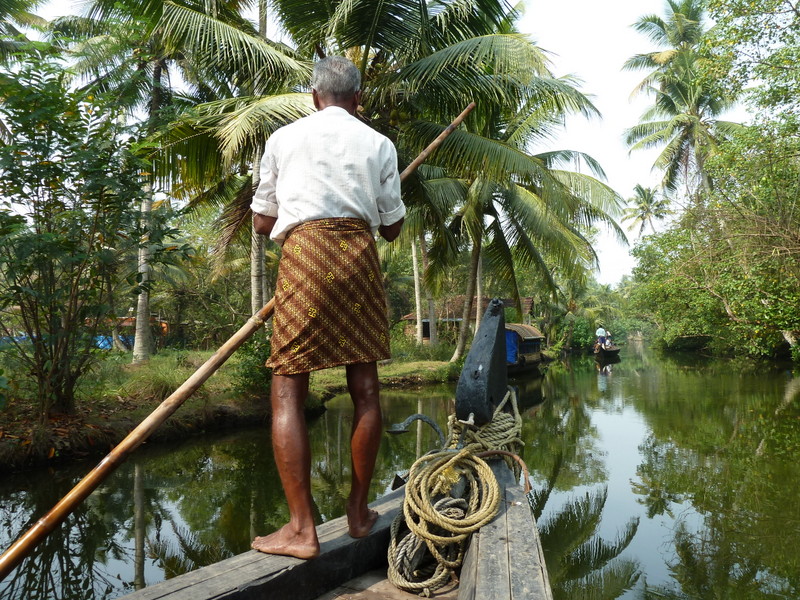
In contrast to the crowds of the wildlife reserves, we enjoyed 24 hours of utter peace on a punted houseboat in the Keralan backwaters. Initially put off by the knowledge that there are over 1000 motorised houseboats in Kerala, we were lucky to find one of the few companies offering a more ecofriendly traditionally punted craft, in a very quiet area of the backwaters. We set off with a crew of three, two boatmen and a cook, to explore the canals and lagoons that make up this part of India. It felt very decadent lounging in the shade in deckchairs while all the hard work was done for us, and mounds of delicious Keralan dishes piled in front of us. The waters were mirror still, the boat cutting through reflections of the palm trees that line the canal banks.

Punting through the peaceful backwaters

Traditional cantilevered Chinese fishing nets on bamboo frames dipped below the surface, and we watched kingfishers dart along the bank and a white headed eagle plunge to the water, emerging with a shining fish wriggling between its talons. We were very lucky to be in an area with no motorised boats at all. The locals travel by wooden canoes, and they were all ridiculously friendly. Everyone we passed met us with big grins and wanted to exchange names and 'how do you do's. Inbetween these meetings there was only the sound of birdsong and the splash of the bamboo pole used as a punt. Best of all was when we took a walk across from the backwaters to a palm fringed beach covered with colourful wooden boats and friendly fishermen. The morning's catch was being brought in, and basket after basket of silver sardines were carried from the heavily laden canoes and lined up on the sand. To be there, far from the tourists of other beaches, was really special and we were made to feel very welcome. In the evening we took out a canoe to explore a bit further around the canals on our own, as fishermen laughed at the sight of a white couple in a canoe and children waved from the banks. It was as idyllic a trip as we could have hoped for.

Unloading the sardine catch

There's so much more I could write about the last couple of weeks- the Portuguese flavour and antique curio lined lanes of Fort Cochin (by far our favourite Indian town), racing through the night on a rickshaw to try and beat the transport ban of an all India strike, drinking tea at source in the plantations of the hills, snacking on fresh cinnamon leaves and seeing possibly the biggest lemon in the world in a spice garden, posing for numerous family pictures in the botanical gardens of Ooty (we must be on a mantelpiece somewhere in India by now!), trekking through colourful villages and eucalyptus forests, experiencing the decorated elephants and flaming torches of a Hindu temple festival... But I think it's time to leave this entry and get back to eating banana fritters and watching the countryside go by through the train window.

Elephants at the Shiva festival
Chinese fishing nets at Fort Cochin
 
The world's largest lemon?!

Tomorrow we leave mainland India for the coral reefs and crocodiles of the Andaman Islands, an isolated archipelago much closer to Indonesia than India. We're very excited about what we might find there, the possibility of some surfing for Karl and the opportunity to dive and snorkel in warm, clear waters (sorry to anyone reading this while at work!).

Harriet